
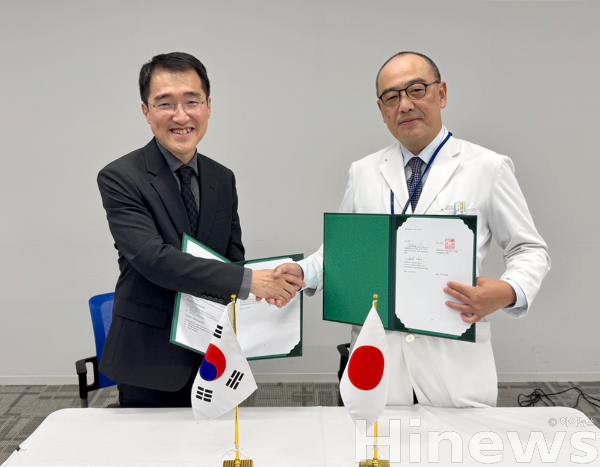
Seoul Asan Medical Center Partners With Japan’s QST Hospital on Heavy Ion Therapy Expansion
Under the pact, the two institutions will collaborate on training specialized personnel, patient referrals, and joint clinical research. Seoul Asan plans to leverage QST’s expertise as it prepares to install its own heavy ion system by 2031.
The equipment slated for Seoul will treat prostate, pancreatic, and liver cancers, as well as lung cancer, sarcomas, renal cell carcinoma, and recurrent tumors. A multi-ion beam platform capable of delivering carbon, helium, neon, and oxygen ions will minimize damage to healthy tissue while maximizing tumor control.
The new facility, to be built on the hospital’s Pungnap-dong campus in Songpa District, will span 40,880 square meters. It will house two rotating gantries, one fixed beam line, and CT-guided imaging to enable adaptive, precision treatment as tumors evolve.
Lim Hye Jung / press@themedik.kr


Headlines
-
 K-medical
Why Korean Dermatologists Will Ask You to Remove Your Makeup — and Why They Are Right
-
 K-Culture & Travel
Your Essential Guide to Seoul's T-Money Card: Save Money and Travel Smarter in South Korea
-
 K-medical
What to Do If You Fall Ill in South Korea: A Traveler's Guide to Fast, Affordable Emergency Care
-
 K-medical
Why Winter Is Prime Time for Medical Tourism in South Korea
-
 K-medical
Seoul’s Cutting-Edge Clinics or Busan’s Healing Coast: Choosing Your Perfect Korean Medical Journey
-
 Wellness
Why ‘People Don’t Change Easily’ Is Only Half the Story: The Psychology of Personality vs. Character
-
 Healthcare
Finding a Lump in Your Breast: Why It’s Not Always Cancer and What to Do Next
Doctors & Hospitals
-
 Healthcare
Why Some Patients Stop Responding to Botox — and How to Prevent It
-
 Healthcare
Eczema: Blending Conventional Relief With Korean Herbal Medicine for Lasting Skin Health
-
 Healthcare
Warts: Beyond Simple Removal—Focus on Immunity for Lasting Relief
-
 Healthcare
AI-Powered Smartphone Tool Opens New Path for Early Autism Screening in South Korea
-
 News
News
Korean Surgeon Pioneers Remote Bladder Cancer Surgery Training Using Da Vinci 5 Platform
-
 Healthcare
Myocardial Infarction Risks Surge in Fall: How to Protect Your Heart
-
 Healthcare
Innovative Korean Acupuncture Therapy Offers Hope for Acne Scar Treatment

Media Introduction | Advertising Partnership
Contact us
Email : press@themedik.kr
All content on medi·K is protected by copyright. Unauthorized reproduction, distribution, or use of any material without permission from Health in News is strictly prohibited. © medi·K, All Rights Reserved.